Ghana Backgrounders
-
Ghana Attractions
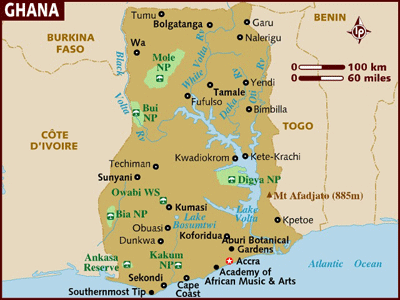
AccraGhana's seaside capital is a savoury blend of big-city bustle and African ease. At once sprawling...
Travellers rave about the coastal area west of Accra, which boasts old slave-trading forts and fishing...
Kakum National ParkMost people visit Kakum as a day trip from Cape Coast, but if you want to stay you can...
KumasiAt one time the capital of the rich and powerful Ashanti kingdom, today Kumasi is a bustling...
Mole National ParkFace-to-face encounters with bus-sized elephants, plus roving gangs of baboons, warthogs,...
Copyright 2010 Lonely Planet Publications, all rights reserved, used with permission
-
Ghana Environment
Ghana has a tropical equatorial climate, which means that it’s hot year-round with seasonal rains. In the humid southern coastal region, the rainy seasons are from April to June, and during September and October; the dry months, November to March or July and August, are easier for travelling. Throughout the year, maximum temperatures are around 30°C, dropping three or four degrees during the brief respite between rainy seasons. The humidity is constantly high, at about 80%.
In the central region, the rains are heavier and last longer. In the hotter and drier north, there is one rainy season, lasting from April to October. Midday temperatures rarely fall below 30°C, rising to 35°C and higher during December to March when the rasping harmattan wind blows in from the Sahara.
Copyright 2010 Lonely Planet Publications, all rights reserved, used with permission
-
Ghana Facts
- Full Name: Republic of Ghana
- Capital City: Accra
- Area:
- 238,540 sq km
- 92,100 sq miles
- Population: 21,000,000
- Time Zone: GMT/UTC +0 ()
Languages:
English (official)
Ewe (other)
Ga (other)
Twi (other)Seasons: Wet (late April to October), dry (November to late March)
- Religion: Christian (70%), Muslim (15%), traditional African religions (15%)
- Currency: Cedi; US$1 = C1.41
- Electricity: 220V/240V 50HzHz
- Electric Plug Details: British-style plug with two flat blades and one flat grounding blade

- South African/Indian-style plug with two circular metal pins above a large circular grounding pin

- Country Dialing Code: 233
Copyright 2010 Lonely Planet Publications, all rights reserved, used with permission
-
Ghana Getting Around
Boat
A passenger boat, the Yapei Queen,runs along Lake Volta between Akosombo and Yeji, stopping at the town of Kete-Krachi and a few villages along the way. In theory it leaves the port at Akosombo at 4pm on Monday and arrives in Yeji on Wednesday morning; in practice the departure and arrival times are more fluid. The southbound service leaves Yeji around 4pm on Wednesday and arrives in Akosombo on Friday morning. Tickets cost US$11/5.50 in 1st/2nd class, and food and drinks are available on board. If you want one of the two 1st-class cabins (recommended), you have to reserve at least two weeks in advance; call 0251-20686 in Akosombo to make a booking.
Bus & tram
The best bus service in the country is provided by VanefSTC, the old State Transport Corporation now owned by Greyhound. There are two classes of bus: ordinary and luxury. The latter have air-con and are newer and more comfortable. Compared to other transport in the region it’s fairly reliable, though late departures are all too common. Expect significant delays leaving from the Tudu station in Accra and on any of the less regular routes. Buses link the major centres, including Accra, Kumasi, Takoradi, Cape Coast, Tamale and Bolgatanga. Other operators, which may have the only buses on some routes (such as between Tamale and Mole National Park), include OSA, Kingdom Transport Services (KTS), City Express and GPRTU. The buses tend to be older and less comfortable.
Train
Ghana’s railway links Accra, Kumasi and Takoradi but the trains are much slower and aren’t any cheaper than motorised transport. There are daily passenger services in either direction between Accra and Kumasi (US$4.40/2.70 in 1st/2nd class, about 12 hours) and a nightly service between Accra and Takoradi, which costs about the same and takes at least 12 hours, but these are really only for masochists and train enthusiasts. However, the line between Kumasi and Takoradi (US$4.40/2.70 in 1st/2nd class) is worth considering. On this line, there are two trains daily, leaving at 6am and 8.30pm. The journey in theory takes eight hours but it’s usually more like 12 in practice, especially on the night train.
Air
Two domestic airlines, Citylink(312001; www.citylink.com.gh) and Antrak(21-765337; Antrak House, Danquah Circle, Osu; Kumasi 51-41296; Tamale 71-91075) operate in Ghana. Both have two flights daily between Accra and Kumasi (US$60 to US$80, 45 minutes), and Antrak has flights on Wednesday, Friday and Sunday between Accra and Tamale (US$144, 1½ hours).
Copyright 2010 Lonely Planet Publications, all rights reserved, used with permission
-
Ghana Getting there and away
Land
Burkina Faso
Between Accra and Ouagadougou, the usual route is via Kumasi, Tamale, Bolgatanga, Paga and Pô. A direct VanefSTC bus runs to Ouagadougou from Accra (US$29, 24 hours) once daily Monday to Saturday and from Kumasi (US$21, 20 hours) every Wednesday evening; most people do the trip in stages. From Bolgatanga, there are frequent tro-trosto the border at Paga (US$1.10, 40 minutes), from where you can get onward transport to Pô and Ouagadougou.
You can also enter Burkina Faso from the northwest corner of Ghana, crossing between Tumu and Léo or from Hamale or Lawra and onto Bobo-Dioulasso. You can reach Tumu most easily from Bolgatanga, Hamale from Bolgatanga or Wa, and Lawra from Wa.
Côte d'Ivoire
Vanef STC buses run between Accra and Abidjan (US$12, 12 hours) via Elubo once daily Monday to Friday, leaving in the early morning. The Ecowas Express, run by STIF, a company from Côte d'Ivoire, does three runs a week between Neoplan motor park in Accra and Abidjan. From Takoradi, Peugeot bush taxis make a daily trip to Abidjan.
Another border crossing lies between Bole and Bouna, though this involves a chartered canoe trip across the Black Volta River.
Togo
Tro-trosand buses regularly ply the coastal road between Accra and Aflao (all about US$3.30, three hours). VanefSTC buses leave from the smaller Tudu bus station in Accra (US$5, four times a day). The border at Aflao is open from 6am to 10pm daily but you should cross between 9am and 5pm if you need a Togolese visa at the border. Public transport from Ghana doesn't cross the border, which is only 2km from central Lomé.
Air
Ghana's only international airport is Kotaka international airport in Accra. At the time of research, the national carrier Ghana International Airways only had flights into London. North American Airlines has one nonstop flight a week between New York City and Accra.
Airlines servicing Ghana include the f
-
Ghana History
History
Present-day Ghana has been inhabited since 4000 BC, filled by successive waves of migrants from the north and east. By the 13th century several kingdoms had developed, growing rich from the country’s massive gold deposits and gradually expanding south along the Volta River to the coast.
Power & conflict
By the 16th century one of the kingdoms, the Ashanti, emerged as the dominant power, conquering tribes left, right and centre and taking control of trade routes to the coast. Its capital, Kumasi, became a sophisticated urban centre, with facilities and services equal to those in Europe at the time. And it wasn’t long until the Europeans discovered this African kingdom. First the Portuguese came sniffing around the coast, and then came the British, French, Dutch, Swedes and Danes. They all built forts by the sea and traded slaves, gold and other goods with the Ashanti.
But the slave trade was abolished in the 19th century, and with it went the Ashanti’s domination. By that time the British had taken over the Gold Coast, as the area had become called, and began muscling in on Ashanti turf. This sparked several wars between the two powers, which culminated in the British ransacking of Kumasi in 1874. The British then established a protectorate over Ashanti territory, which they expanded in 1901 to include areas to the north. The Gold Coast was now a British colony.
The road to independence
By the late 1920s the locals were itching for independence, and they set up political parties dedicated to this aim. However, parties like the United Gold Coast Convention (UGCC), formed in 1947, were too elitist and detached from those they were meant to represent – the ordinary workers. So the UGCC’s secretary-general, Kwame Nkrumah, broke away in 1948 and formed the Conventional People’s Party (CPP), which became an overnight success. Nkrumah was impatient for change and called for a national strike in 1949. The British, anxious about his popularity, jailed him. Despite this, the CPP won the elections of 1951, Nkrumah was released and he became prime minister. When Ghana finally won its independence in March 1957, Nkrumah became the first president of an independent African nation. His speeches, which denounced imperialism and talked about a free, united Africa, made him the darling of the Pan-African movement.
Independence & the Nkrumah years
But back home Nkrumah was not popular among traditional chiefs and farmers, who were unimpressed with the idea of unity under his rule. Factionalism and regional interests created an opposition that Nkrumah tried to contain through repressive laws, and by turning Ghana into a one-party state.
Nkrumah, however, skilfully kept himself out of the fray and concentrated on building prestige projects, such as the Akosombo Dam and several universities and hospitals.
But things started to unravel. Nkrumah expanded his personal bodyguard into an entire regiment, while corruption and reckless spending drove the country into serious debt. Nkrumah, seemingly oblivious to his growing unpopularity, made the fatal mistake of going on a state visit to China in 1966. While he was away his regime was toppled in an army coup. Nkrumah died six years later in exile in Guinea.
Dr Kofi Busia headed a civilian government in 1969, but could do nothing to overcome the corruption and debt problems. Colonel Acheampong replaced him in a 1972 coup, but few things changed under his tenure.
Jerry Rawlings’ regime
By 1979 Ghana was suffering food shortages and people were out on the streets demonstrating against the army ‘fat cats’. Onto the scene came Jerry Rawlings: a good-looking, charismatic, half-Scottish air force pilot who kept cigarettes behind his ear and spoke the language of the people. Nicknamed ‘Junior Jesus’, Rawlings caught the public’s imagination with his calls for corrupt military rulers to be confronted and held accountable for Ghana’s problems. The military jailed him for his insubordination, but his fellow junior officers freed him after they staged an uprising. Rawlings’ Armed Forces Revolutionary Council (AFRC) then handed over power to a civilian government (after a general election) and started a major ‘house-cleaning’ operation –that is, executing and jailing senior officers.
The new president, Hilla Limann, was uneasy with Rawlings’ huge popularity, and later accused him of trying to subvert constitutional rule. The AFRC toppled him in a coup in 1981, and this time Rawlings stayed in power for the next 15 years.
Although Rawlings never delivered his promised left-wing revolution, he improved the ailing economy after following the orders of the International Monetary Fund (IMF). During part of the 1980s Ghana enjoyed Africa’s highest economic growth rates
The democratic era
By 1992 Rawlings was under worldwide pressure to introduce democracy, so he lifted the 10-year ban on political parties and called a general election. However, the hopelessly divided opposition couldn’t get their act together, and Rawlings won the 1992 elections freely and fairly, with 60% of the vote. Still licking their wounds, the opposition withdrew from the following month’s parliamentary elections, giving Rawlings’ newly formed National Democratic Congress (NDC) an easy victory. In 1996 he repeated this triumph in elections that were again considered free and fair.
Ghana today
After eight years of Rawlings and the NDC (the constitution barred Rawlings from standing for a third term in the 2000 presidential elections), his nominated successor and former vice-president, Professor John Atta Mills, lost to Dr John Kufuor, leader of the well-established New Patriotic Party (NPP), which also won a slim majority in the parliamentary elections. Kufour and the NPP were victorious again in 2004, which means that each party will have had eight years in power by the time the next national elections roll around.
Kufuor and the NPP inherited some tough economic and political challenges; the party’s slogan, ‘So Far So Good’, is perhaps an uncannily accurate reflection of the confidence they and the country hold. Even though both parties continue to be criticised for cronyism and corruption, Ghana’s economy continues to grow and attract investment, and the outlook is brighter than in many other parts of Africa. That being said, in 2005 the per-capita income was an estimated US$2500 and Ghana is classified by the UN as a low-income, food-deficit country. The majority of very poor people live in rural areas. The bulk of the country’s labour force is employed in agriculture, which accounts for 37% of its GDP and 35% of its export earnings.
Copyright 2010 Lonely Planet Publications, all rights reserved, used with permission
-
Ghana Introduction
If an award were given for the country with the friendliest people in West Africa, Ghana would be a strong contender. Spend a few hours in the breezy capital at Accra, and you'll swear the wind and waves off the Gulf of Guinea have infused the land and people alike with equatorial warmth.
-
Ghana Money
Money
The unit of currency is the cedi (C). There are C1000, C2000, C5000, C10, 000 and C20, 000 notes, as well as C100, C200, C250 and C500 coins.
The best currencies to bring are US dollars, UK pounds or euros. Barclays and Standard Chartered Banks exchange cash and well-r
-
Ghana Sample Itinerary
SATURDAYSUNDAYMONDAYTUESDAYWEDNESDAYTHURSDAYFRIDAYSATURDAY11:00amVolunteer pickup @ Pink hostel.7:00amBreakfast.7:00amBreakfast.7:00amBreakfast.7:00amBreakfast.7:00amBreakfast.7:00amBreakfast.7:00amBreakfast.2:30pmLunch.9:00amChurch service with the community members.8:30amConstruction Site.11:00amTeaching Kindergarten Kids.8:30amConstruction Site.11:00amTeaching Kindergarten Kids.8:30amConstruction Site.11:00amTeaching Kindergarten Kids.8:30amVisit to the Waterfall and the Monkey sanctuary at Wli and Tafi Atome respectively in the Hohoe Municipality.8:30amConstruction Site.11:00amTeaching Kindergarten Kids.8:30amDeparture to Accra.3:00pmDiscuss project itinerary.1:30pmLunch.1:30pmLunch.1:30pmLunch.1:30pmLunch.1:30pmLunch.3:30pmMeeting the Chief and Elders of Kpedze-Todze.3:00pmCultural Performance by members of Kpedze-Todze.3:00pmVisit to Kpedze market / Drumming lesson.3:00pmVisit to the Palm wine tapping base/ Drumming lesson.3:00pmVisit to the Kente village, Craft shop, Local fabric shop and Ho central market.3:30pmMeeting the Chief and Elders of Kpedze-Todze.5:00pmFree Time.5:00pmFree Time.5:00pmFree Time.5:00pmFree Time.5:00pmFree Time.5:00pmFree Time.6:00pmDinner and Discuss day activities.6:00pmDinner and Discuss day activities.6:00pmDinner and Discuss day activities.6:00pmDinner and Discuss day activities.6:00pmDinner and Discuss day activities.6:00pmDinner and Discuss day activities.6:00pmDinner and Discuss day activities. -
Ghana When to go
There really is no 'best' time to visit Ghana, as the temperature is always Africa-hot and if rainfall doesn't soak you, then the humid air will. If you prefer your soaking tropical in nature, stick close to the beaches. Whatever the season, the weather gets more arid the farther inland you go. Village-specific festivals and events occur throughout the year.
The tourist high season is from June to August, which coincides with the summer vacation in the US. The country sees few tourists from September to December.
Copyright 2010 Lonely Planet Publications, all rights reserved, used with permission
-
Ghanaian Culture
Ghanaian Culture – Quick Facts, Travel Hints, & Tips
 About the People
- Ghana has a population of about 18 million.
- There six major ethnic groups in Ghana – the Akan, Ewe, Ga-Adangbe, Mole-Dagbani, Guan, Gurma. The largest tribe are the Ashanti, with their traditional capital at Kumasi.
- The largest tribe in the Volta region (in which Globe Aware operates) are the Ewe.
- Ghana was the first African country to gain independence and is one of the most stable democracies in the developing world.
Personal Space & Interactions- For those accustomed to personal proximics in Eastern, Western, and Latin American cultures might be very surprised by how close Ghanaians get to each other and to you.
- Ghanains will approach very close to you when speaking, and may attempt to hold your hand. Do not take offense, as this is normal.
- You will often see Ghanaian men and boys walking while holding hands. Do not assume that this has any implications for their sexual orientation.
- Personal greetings vary depending on the ethnic group. One standard is the finger clicking handshake with which you will likely become very familiar.
- If giving gifts, they should be given with the right hand. They are not necessary when visiting for dinner, and the thought is more important than the cost. They may not be opened when received, but this is not meant as an offense.
- It’s generally a good idea to avoid direct eye contact for extended periods, as it is sometimes considered impolite.
Leisure Time- Festivals are ubiquitous in Ghana. Some of the largest are Panafest, and Homowo. Homowo literally translates to ‘making fun of hunger’. It was traditionally held after a harvest.
The Food- The most common feature of Ghanaian cuisine is soups.
- The most common soups are light soup, palmut soup, and groundnut soup.
- Fufu is one of the more common and popular dishes. Produced by pounding plaintain, cassava, or yam, you wrap other foods in it and enjoy!
- A very popular dish is Jolof rice. It’s a race dish with tomatoe sauce and chicken. You may find it similar to dishes from around the Carribean and New Orleans in the US (namely Jyambalaya or dirty rice). This is not a coincidence, as many of those dishes owe their origins to West African cuisine.
- Fish dishes are very popular and very good in Ghana.
- You’ll find many distinct sauces and spices used in preparing dishes.
Transportation- The most ubiquitous form of transportation in Ghana is the Tro-Tro. These are van like vehicles that load up on passengers and proceed along regular routes. Be careful that you choose a vehicle that appears to be in good condition.
- Tro-tros will typically have a “small boy”. These are young men who rustle up passengers and collect fares.
- Tro-tros can get very packed, so be prepared to squeeze in. They’re a very culturally distinct form of transportation and you’ll likely remember the experience for the rest of your life.
- Chartered buses and taxis are also cheap and widely available.
Education.- The Republic of Ghana has 12,630 primary schools (of which Globe Aware has built 2), 5,450 junior secondary schools, and 503 senior secondary schools, 21 training colleges, 18 technical institutions, and five universities.
- Entry to university is determined by examination.
Languages- English is Ghana’s official language.
- Other major languages spoken are tied to the various major ethnic groups. They include Twi, Fante, Ga, Hausa, Dagbani, Ewe, & Nzema.
- Ghanaian language and communications are rife with proverbs. Euphemisms are also very common linguistic tools.
Economy- Ghana is primarily agricultural. Common crops are Okra (pronounced Okro), bananas, and mangos.
- Mining and petroleum also make up a not-insignificant part of the economy. Furthermore, recent major oil discoveries in Ghana point towards these industries playing an even larger role in the economy’s future.
- Ghana has a relateively advanced industrial base. Auto assembly, oil refining, flour milling, textiles, and simple consumer goods are all manufactured at various locations throughout Ghana.
- Tourism is one of the largest industries in modern Ghana. Ghanaians like to see their country as the gateway to Africa.
Religion- 60% of Ghanaians are Christian. 50% are Muslim, 25% traditional African religion.
- Ghana has the highest percentage of Christians in West Africa. Christian sects present include Mormonism, Baptists, and others.
Music- As in many African countries, you will find that Rhythm is central to much of Ghana’s musical stylings.
- You will see the many different drums and drum styles on display at tribal/community gatherings during your stay.
- There many distinct instruments found within Ghana. Famous instruments include the talking drum, the Atsimevu, the Gankogui (a type of gong or bell used in Ewe music particularly), and others.
- Hip Hop is extremely popular in Ghana, as is Reggae.
- Dancing is a key ingredient to appreciating Ghanaian and African music.
Globe Aware has gathered more tips, hints, and facts on Ghanaian culture from numerous sources in print, past volunteers and staff, and on the web. Find out more by registering today and experiencing genuine Ghanaian culture, from the drums and rhythm to the Fufu, for yourself!